


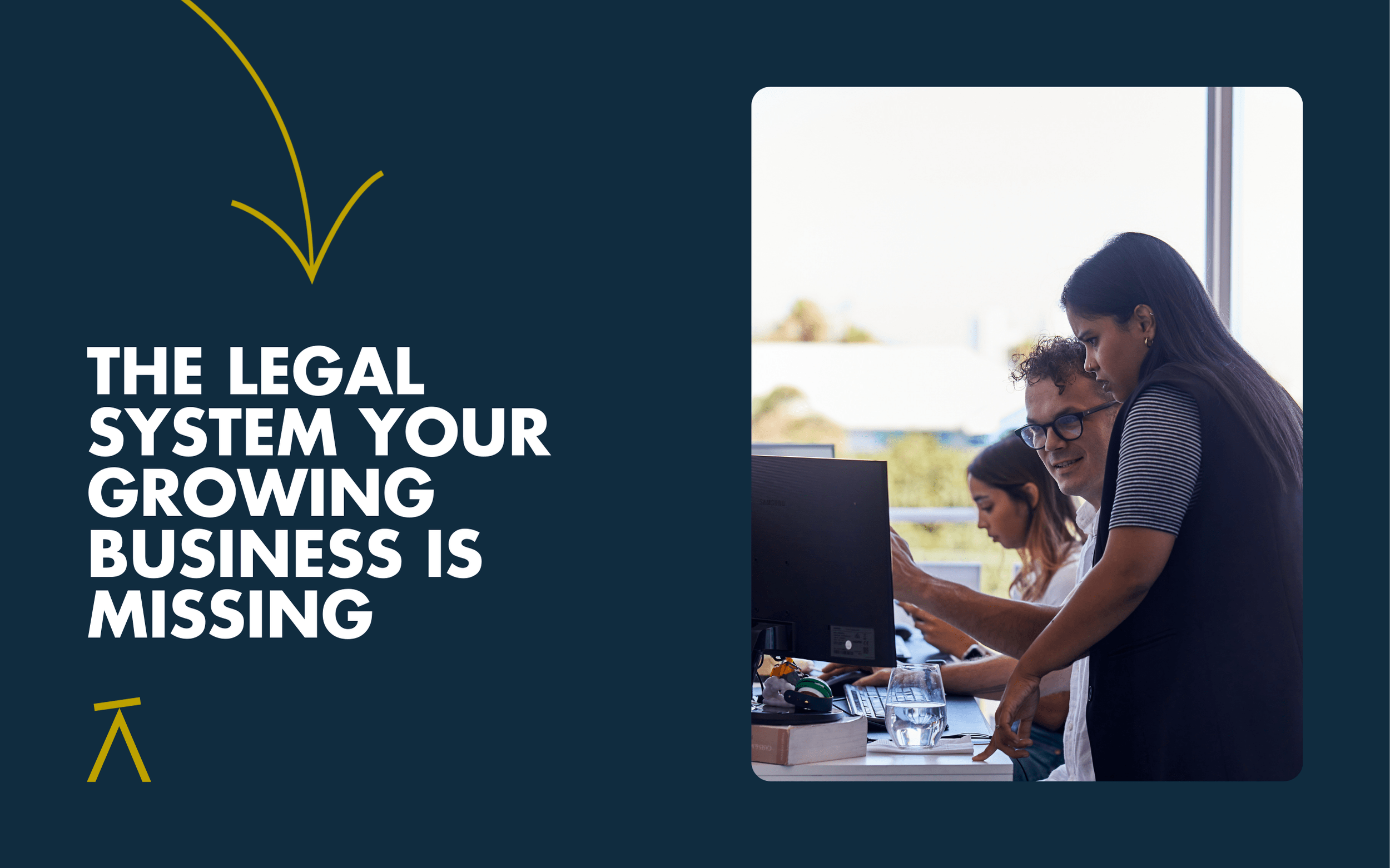
As businesses grow, complexity increases.
More employees.
More contracts.
More partnerships.
More compliance obligations.
More legal risk.
But most companies never install a structured legal system to manage that growth.
Instead, they rely on a patchwork of outdated templates, verbal agreements and the assumption that problems can always be fixed later.
Unfortunately, by the time legal issues surface, the cost of fixing them is often far higher than the cost of preventing them.
This is where a Legal Operating System becomes critical.
What Is a Legal Operating System?
A Legal Operating System is the structured legal framework that supports a business as it grows.
Instead of handling legal matters on an ad-hoc basis, companies implement clear systems that govern how legal risk is managed across the organisation.
A proper legal operating system typically includes:
- Standardised commercial contracts
- Clear intellectual property ownership structures
- Employment agreements and HR frameworks
- Compliance monitoring processes
- Governance and decision-making protocols
These systems ensure that legal considerations are built into the way the business operates — not only addressed when something goes wrong.
Why Most Growing Businesses Lack Legal Structure
Many businesses start informally.
In the early stages, founders move quickly and prioritise growth over structure.
Contracts are downloaded from the internet.
Agreements are confirmed over email or WhatsApp.
Intellectual property ownership is assumed rather than documented.
This often works for a while.
But as the business grows, the lack of legal infrastructure begins to create risk.
Disputes arise over unclear contracts.
Employee relationships become complicated.
Partnership expectations are misunderstood.
Compliance obligations increase.
Without a clear legal framework, these issues can quickly become expensive.
Why Legal Infrastructure Matters for Scaling Businesses
A well-designed legal system does not slow down growth.
It stabilises it.
When businesses implement structured legal frameworks, they gain:
- clear contractual relationships
- reduced legal disputes
- stronger governance
- improved compliance
- greater operational certainty
Instead of constantly reacting to problems, leadership teams can focus on scaling the business with confidence.
Legal becomes part of the infrastructure that supports growth — not an emergency service used during crises.
Scaling Without Legal Structure Is Risky
Scaling a company without legal infrastructure is similar to adding additional floors to a house without reinforcing the foundation.
At first, everything appears stable.
But as weight increases, structural weaknesses start to show.
Eventually something cracks.
A Legal Operating System ensures that the foundation of the business is strong enough to support growth.
Build the Legal Foundation Your Business Needs
Every growing business reaches a point where informal legal arrangements are no longer sufficient.
The next stage requires structured legal systems that support scale.
If you want to understand where your legal risks currently sit — and what systems your business should have in place — the first step is identifying the gaps.
Book a Legal Roadmap Session to start building the legal infrastructure your business needs to scale safely.

Share:


AI Governance in South Africa: Why Your Business Needs More Than an AI Policy
AI is already part of how businesses work. Your team might be using ChatGPT to draft content, AI tools to analyse documents, meeting assistants to capture conversations, or software with
Read more
What is an Indemnity Form and How Does It Work?
An indemnity form is a contractual document where one party (the indemnitor) agrees to compensate another party (the indemnitee) for any losses or damages incurred. This form is commonly used
Read more
What Is a Fractional Legal Officer And When Does Your Business Actually Need One?
Most growing businesses don’t need a full-time legal department. But they absolutely need a legal strategy. A Fractional Legal Officer is a flexible support model that can provide ongoing legal
Read more